Mountain Road
Got map?
Staying above the water line!
Riverwalker


You should always bring an ample supply of water for drinking when on a wilderness outing. Don’t forget to include some additional means of water purification, such as water purification tablets, a filter, or the means to make a fire in order to boil any water you may find. While a lack of food may make you uncomfortable, a lack of water will cause serious problems such as dehydration. The effects of dehydration happen quickly. Anyone can get lost or have an accident and lose a vital water supply. Should you find yourself stranded or lost in the wilderness for several days or just a few hours, you need to be able to locate a source of drinking water in order to survive.
Finding Water Sources in the Wilderness
1.) Move in a downhill direction. Water naturally flows in a downward direction and will sometimes collect in small depressions, hollows or rocky crevices.
2.) Be aware of the insects in your area. Insects will often be a sign of water in the area. Although the mosquitoes will probably find you first, they, along with other types of insects, are a good indication of the presence of water.
3.) Listen for the sound of moving water. Rivers and streams can be some of the easier sources of water to locate in a survival situation. They usually make a distinctive sound that can be heard quite easily if you stop for a moment and listen for the sounds of rushing water.
4.) Look for a large number and variety of animal tracks. The presence of a large number of animal tracks will quite often indicate a natural water source that is nearby and may help you to find or locate a water source in your immediate area.
Nature will help you to find water if you understand the signs that are present everywhere in the wilderness. If you understand and respect nature, you will survive.
Staying above the water line!

Rocky overhangs, ledges, depressions in the rock face and caves can be excellent survival shelters. They can also be enhanced in a variety of ways to make a better and more effective shelter using additional brush, sticks and tree limbs, etc. that may be available in the area. Even if there are no additional materials available they can be a much better alternative than being openly exposed to the elements.
Natural shelters can quite often satisfy the basic shelter needs in a survival situation. The primary purpose of any survival shelter is to help you preserve body heat by protecting you from the elements of nature. Being protected from the wind, rain, sun or cold will be necessary in order to preserve your body heat and help you avoid the effects of hypothermia which is a major killer in survival situations.
Simple Survival Tips for Using Natural Shelters
1.) Avoid spots where you might get wet. Check for signs of water stains, running water etc. that may become a problem.
2.) Check to make sure there are no present occupants residing in the area. Most wildlife will react unkindly towards you if you invade their home or try to evict them.
3.) Always insulate yourself from the ground to avoid the loss of body heat.
4,) Use only the minimum amount of space needed. You’ll have a smaller area to heat in order to preserve body heat if no fire is available.
5.) If you do have the ability to make a fire, make sure you have adequate ventilation.
Any type of survival shelter in a wilderness setting has to be able to preserve your body heat and protect you from the elements of nature.
Staying above the water line!
Riverwalker


When faced with a survival situation, one of the basic things that will be required is regular meals. Regular meals will be necessary to maintain proper nourishment and nutrition. You will be expending energy and will need to plan for regular meals to help avoid stress and fatigue. This makes meal planning essential if supplies or resources are limited after a crisis or disaster.
Tips for Survival Meals
1) Keep the meals simple and plan as many “one-dish” meals as possible.
2) Use recipes that don’t require special cooking equipment or preparation.
3) Limit yourself to one pot or one pan when preparing a meal. Less clean-up effort is needed afterwards.
4) Use simple and very basic ingredients. Using complicated recipes will only add to the frustration and stress of a survival situation.
5) Plan daily meals ahead of time but be flexible in case circumstances change and smaller meals (rationing) become necessary.
6) Include meals in your planning that can be eaten “as is” for those times when cooking a meal may not be possible.
7) Avoid cooking extra. Left-overs will perish quickly if power sources are out and proper conditions to prevent spoilage are unavailable.
8) If you do have left-overs, they will probably need to be eaten as quickly as possible and should be incorporated into the plans for your next meal.
9) Use only tested recipes and food items that you know family members will eat. Avoid experimenting with new recipes in a survival situation.
9) Don’t be afraid to repeat the use of basic food items in your meals.
10) Include some “survival snacks” for variety and nutrition.
Keeping things simple and uncomplicated during a crisis or disaster will aid you in your survival efforts.
Got survival menu?
Staying above the water line!
Riverwalker

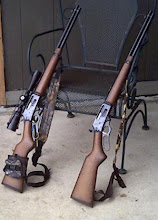
Many rifle owners quite often overlook a very important safety practice when using telescopic sights on their rifle. The safe use of your rifle should always be a primary concern for your safety and the safety of others around you. Relying on your telescopic sights when hunting for long range spotting can be a very dangerous practice.
It's a lot safer to carry a good pair of binoculars for use in long range spotting instead of using the telescopic sight mounted on your hunting rifle. When using the telescopic sight on your rifle in this manner, your rifle will be in the firing position and pointed in the target’s direction. If someone or something that is not an intended target winds up in the telescopic sights of your rifle, you will also be violating one of the most important rules of gun safety.
Never point your rifle at anything or anybody unless you intend to fire.
It’s a lot safer to carry a good pair of binoculars to use for long range spotting.
Got binoculars?
Staying above the water line!

Storm shelters are a vital necessity in many parts of the country. The threats from tornadoes and other severe storms are a very real danger to your survival. My area is no exception and having a good storm shelter is one of the areas where my preparations have been inadequate. This is a situation that needs to be addressed and has been moved to the top of the list of things that need to be done. You should also realize that creating and planning the most effective and efficient design possible for your storm shelter will be what makes your chances for survival a success.
LOCATION
After considering several different types of storm shelters, it seems that a shelter that takes advantage of your natural surroundings will probably be one of the safest means possible to weather a severe storm. Many creatures in our natural environment survive devastating storms by simply taking advantages of natural shelter that is available. Sometimes their shelter is little more than a hole in the ground and yet they manage to survive. The location for your storm shelter should blend in with the shape and contours of your surroundings which will make it less obtrusive to your daily life but also be there if and when it is needed. Building an effective and efficient storm shelter will require a great deal of planning in order to insure your survival. Your long term survival is largely dependent on your ability to survive the short term effects of a severe storm.
MATERIALS
While there are many types of commercially built storm shelters available, most can be cost prohibitive for many people. With some time, effort and a little research, you should be able to design and build an effective storm shelter that can fit into your budget. If you’ve got plenty of money or received a big tax refund this year, it may not be a problem for you and one of the commercially available shelters may be more appropriate for your needs. Certain classic storm shelter designs are based on steel or concrete construction or a combination of these two materials. Newer and more modern designs are being based on fiberglass structures that offer strength similar to steel and concrete but don’t have the long term disadvantages of rust or deterioration. The fiberglass option seems to be the type that will best suit my needs based on my own research into storm shelters. It also offers the option for moderately easy repairs through the use of readily available fiberglass repair kits. It will probably be in combination with some type of geo-mass such as mounds of soil, bags of dirt or rocks.
More considerations on my plans for building a storm shelter will be forthcoming in Part Two.
Got hole in the ground?
Staying above the water line!
Riverwalker

These are probably mallards and are one of the more common ducks in our area and are found in most flyways. Every year about this time there is a small flock of about 10 to 12 ducks (there may be a few more but it’s hard to get an accurate count) that appear in the trees in my yard. They usually feed in the early morning hours and this is one of the best times to catch them sitting in the trees. If you’re up at the crack of dawn, you can find them sitting in several different trees in my yard. The drakes generally give their presence away when they are in the trees with a very distinctive sound that is a low-pitched ”kwek-kwek”. They are usually grouped in pairs and their appearance is also very similar.
Many ducks shed their body feathers twice a year. The drakes will lose their bright plumage shortly after mating and will look like the hens for several weeks. Most of these ducks are probably mating pairs. This appearance that makes them look like hens is called their “eclipse” plumage and that creates a type of natural camouflage. The length of time they keep this “eclipse” plumage probably varies quite a bit depending upon the type of duck. This can make them difficult to spot when they’re sitting in a tree!

Not all ducks are dumb but that still leaves quite a few that aren’t probably that bright. By way of example, how many ducks can you find in the tree pictured above? Hint: there is more than one!
Mrs. RW has been throwing out corn for them and this is probably one of the reasons they keep coming back each year. They may not be the smartest creatures around but they won’t turn down a free meal.
Personally, the verdict is still out in my opinion as to just how smart ducks actually are and is evidenced by the term “sitting ducks” commonly used to describe things that are exposed to dangerous situations. If Brigid had been here, she would have used some bacon camouflage and these ducks would probably be sitting in a pan in the oven instead of my trees.
Got "sitting ducks" in your trees?
Staying above the water line!

When it gets dark, it gets dark! Unless you’re packing a set of night vision goggles everywhere you go, you will probably find yourself in a situation where having a good source of light handy is going to be necessary. You’ll probably want something a little easier to carry during your everyday activities than a set of night-vision goggles and one of the most compact, portable and highly efficient light sources you can have handy is the iTP-A3-EOS.

The "Upgrade Edition" of the iTP A3 EOS features 3 separate output levels when you need light. The default light level is a medium output of 18 Lumens and gives you a battery life of approximately 4 hours at this output. The low output light level is 1.5 Lumens and gives you a battery life of almost 50 hours and the high output level is 80 Lumens with a run time of approximately one hour. The special aluminum alloy reflector and the Cree 7090-XP-E Q5 LED probably have a lot to do with the high output (80Lumens) of this amazing little flashlight. The best thing is that you get all this light from a single AAA battery! You can also easily switch from one output level to the next in a simple one-handed operation. This is great for when you need at least one hand free.

My upgraded version is the standard black color. It is also available in a standard “natural gray” color and four optional colors; gold, purple, red and blue. The standard model also comes in a sturdy, rugged and lightweight aluminum body that includes a keychain, a sturdy pocket clip and two spare o-ring seals. For the die-hard survival types out there, it’s also available in a Titanium and a Stainless Steel version. All this comes in a little box just slightly larger than a deck of playing cards.

Being smaller than a standard lighter and very lightweight makes it very versatile and easy to carry with you at all times and will work great for your EDC needs.

This is simply a great piece of gear that is available for less than $20 for the upgraded version.
Got dark?
Staying above the water line!
Riverwalker

Although your intended purpose of becoming better prepared may be to enact a major change in your lifestyle, sometimes a simpler approach to that change will be much easier for you to accomplish. Becoming more self-reliant and better prepared for things that come your way may be better approached in a few simple stages. Although some people can endure dramatic changes in lifestyle and even view them as acceptable, for many others drastic changes in lifestyle over a short period of time can quite often be just as devastating as any disaster. There is simply no reason to make that disaster one of your own making.
Simple Stages of Preparedness
1.) Financial Preparedness. Work towards becoming more economically and financially independent. Start by keeping a record of your expenditures. If you don’t know where your money is going, you won’t know where or when you can save extra money to help you reach your preparedness goals. Your finances will be a lot easier to keep track of and you’ll be able to understand where you can save money by eliminating certain items that may not be essential. Small savings will add up to a substantial amount in just a short period of time without creating a major change in your lifestyle.
2.) Mental Preparedness. Learn to do more things on your own and reduce your need for assistance. In other words, become more self-reliant. Begin with small tasks that are easily accomplished and move on to more complicated things as your knowledge and skills grow. It’s also a lot cheaper than paying someone else to do them for you and will save you extra money in the process. Be prepared for those times when assistance is necessary because the task may be outside the realm of your knowledge or skills.
3.) Physical Preparedness. Develop a healthier lifestyle. Learn to eat healthier meals and find ways to exercise more. Monitor any health problems closely. Your health is an important part of your lifestyle and maintaining a healthy lifestyle should be a part of the process.
Simple changes in your lifestyle which are done slowly and systematically will help you reach your preparedness goals much faster and easier than you may have thought possible. You will ultimately need to figure out which path will be the best for you to reach your preparedness goals. The path to preparedness that you eventually choose should be based on your lifestyle, your circumstances and your goals. There is no single path to preparedness that is right for everyone. Not everyone will choose the same path even though they may be similar in many aspects. The path to preparedness should always be based on your own unique needs and circumstances.
Staying above the water line!

Nature has its own way of hiding things in plain sight. Training yourself to be more observant in a wilderness situation will help you find things you may not notice otherwise. Many times wilderness food sources will be rather obvious and other times you won’t even notice them. An eye for detail and the subtle differences in things is sometimes required to see what others do not.
While sometimes wilderness food sources are quite obvious, at other times they will be hidden from your sight in plain view in the most unlikely of places. Your eyes may be open but can you see what is there. Nature’s pantry is all around us and we need only to keep our eyes open to see what is right in front of us.
There is a wilderness food source hidden in the picture above but can you see it?
Look closely or you’ll miss it!
Staying above the water line!

If you are into bushcraft, one of the must have items for your survival library is “
Additional information inside this book includes plans for building dozens of traps and the directions for the building of shanties and log cabins for survival. It also includes directions for the building and construction of boats and canoes, tips on food and cooking utensils and instructions for the curing and tanning of fur skins. There are also some great bait recipes for your traps.
Although the information on the price of fur skins is a little outdated, it still contains a wealth of information for those persons that are truly into bushcraft. It is being provided free in a secure download so that you may add it to your library.
You can preview or download a secure copy of this free bushcraft book here:
Camp Life in the Woods and the Tricks of Trapping.PDF (9.8 MB)
Got bushcraft?
Staying above the water line!
Riverwalker


When the handling of hazardous materials or toxic chemicals is properly done, there is usually little cause for alarm and normally they do not pose a significant threat to your safety. Unfortunately, accidents can and do happen and in the case of a toxic substance or hazardous chemical release they can come suddenly and with very little warning. The release of hazardous or toxic substances may also be intentional due to an act of civil unrest or terrorism. You may have only minutes to respond to the threat in order to protect yourself and your family.
Sheltering in place in the majority of cases is normally a short-term safety procedure. It is designed to provide protection for you and your family if there is a release of toxic or hazardous materials that may affect the air or water quality in your area. If hazardous materials are accidentally or purposefully released into the air or in such a manner that they may affect ground water supplies, you may need to shelter in place for anywhere from several hours to several days. Having a Home Disaster Kit handy will put you in control of the situation should such a crisis occur.
Sheltering in Place - Home Disaster Kit - Basic Contents
1.) Box, bucket or other storage container to hold the basic contents.
2.) Water for drinking.
3.) Food Items - Crackers, hard candy, nuts, canned meats that don’t require refrigeration.
3.) Plastic sheeting to seal A/C and heating vents and to cover & seal door openings.
4.) Duct tape to seal plastic sheeting used to cover vents, windows & door openings.
5.) Knife or scissors to cut and trim plastic sheeting to fit any openings.
6.) First Aid Kit (which includes any needed prescription medications).
7.) Flashlight (include extra batteries) or lantern for light.
8.) Emergency radio and an emergency whistle.
9.) Large trash bags (this will allow the bucket to be used as an emergency toilet)
10.) Hand sanitizer, sanitary wipes and toilet paper
11.) Several large towels to help seal the bottom edges of doorways.
12.) Cell phone or access to a hard-wired landline for emergency communications.
The majority of these items you will probably have available. Simply assemble them in a container and place it where it can be easily accessed in case you need to shelter in place.
Most releases of toxic or hazardous materials won’t require a long time to be properly brought under control during normal circumstances. This will minimize the length of time you will need to shelter in place to just a few hours in the majority of cases. There will generally be no loss of utility services in most cases and unless there has been a serious contamination of ground water supplies, a disruption in natural gas transmission pipelines or a power substation failure, you will usually have normal access to utilities. Don’t rely on this always being the case though because there is always the risk of infrastructure failure that could disrupt utility services.
You can read Part One here:
Sheltering in Place - Home Disaster Kit - Part One
Got HDK when sheltering in place?
Staying above the water line!
Riverwalker

When sheltering in place, always take into account the type of hazard you will be facing and plan accordingly for that particular hazard. Choose the location in your home that will be the safest place for you to avoid or minimize the effects of that hazard. It is a critical decision that should be made in advance when time to avoid the hazard, should it occur, may be limited.
Deciding Factors - The Primary Decisions
1.) Choosing the area within your home for sheltering in place will be the first critical decision. The area or room selected should provide at least ten square feet per person at a minimum. This will provide adequate air to breathe without excess buildup of carbon dioxide. You should also have an alternative area selected in case additional family members or friends are present and more space is required. Your sheltering in place needs will vary by the particular threat that you may be subject to and your plans should take the different scenarios into account. The room or area chosen should always have adequate space for everyone that may be present during the emergency.
2.) Plan to shelter in place the required amount of time to avoid the danger. This could be anything from a few minutes in the case of a tornado or several hours in the case of a hazardous material release. It could be as long as several days in the event of severe flooding and could be as much as a few weeks in the case of a winter storm or blizzard. You will need to plan according to the major threats that could affect you and your family.
3.) The proper size and type of location to shelter in place depends entirely on the type of emergency situation. A safe area from a tornado will be different from the area needed to safely avoid flooding. The need to shelter in place for a short period of time will require less space than an extended period of sheltering in place due to a winter storm. Understanding the differences in the type of threats and the dangers that they may cause is critical for your survival.
The proper knowledge and understanding of the specific actions required when sheltering in place is an important part of being prepared. This will allow you to handle that threat in the best way possible in order to minimize its effects on you and your family.
You can read the first part here:
Sheltering In Place-Deciding Factors - Part One
Staying above the water line!
It seems that many people are seeking a proper way to define a prepper. A prepper may come from many different walks of life and prepare in a variety of different ways. This has made it difficult for many people to define a prepper. Here is a simple definition that may help give you a better understanding of what it means to be a prepper.
Definition of a Prepper
Prepper(s) (noun): An individual or group that prepares or makes preparations in advance of or prior to any change in normal circumstances or lifestyle without significant reliance on other persons (i.e., being self-reliant) or without substantial assistance from outside resources (govt., etc.) in order to minimize the effects of that change on their current lifestyle.
Got definition?
Staying above the water line!

Joshua said...
I’ve found 550 cord to be useful in a variety of situations; most notably for attaching my parachute to my harness when I was jumping out of airplanes in the Army! Aside from that though, it is great for tying things down and rigging tents, use as boot laces, tying up an animal to be butchered, etc. Most of these uses don’t require the full strength of the cord, and things can be tied down better usually after the cord has been “gutted” (interior strands removed). If you have enough pieces of long interior strands, they can be used to fashion a very usable fishing net (this was something I learned to do in the Army). In the Army I used it to tie important pieces of gear to myself or my pack in case they came loose.
It’s definitely one of those essential items I keep around. To me, it’s right up there with my Leatherman and a flint and magnesium fire starter for things that go in the pack for a camping trip or other outdoor excursion.
Joshua, please respond within 72 hours by an e-mail to riverwalker_texas@yahoo.com with a current shipping address in order to receive your free hank of 8 Strand 550 Paracord from Gear Up Europe.com.
Your information will remain confidential and be used only to ship your prize.
Congratulations once again to Joshua! He's a winner!
Visit the International Preppers Network to see the winners there!




 Posts
All Comments
Posts
All Comments