Monday, January 31, 2011
Saturday, January 29, 2011
Riverwalker’s Top Ten Survival Tools
1 1 1. A sharp mind. Your best survival tool is your brain.
2. An even sharper blade. It’s also a good idea to have a back-up blade.
3. A signaling device for communication. This could be as simple as a mirror or whistle or as advanced as a cell phone. Remember that communication is both sight and sound.
4. A first aid kit - Even a very basic first aid kit will be essential and will prevent minor injuries from becoming major problems.
5. A container and a means of water purification and filtration - Water is critical for your survival and you will need a way to purify and filter your water.
6. A fire starting kit - This could include matches, a lighter, or a good firesteel.
7. An accurate map and compass - If you get lost, these items will be a real lifesaver.
8. A form of shelter - A tarp, tent, plastic sheeting, emergency blanket etc.
9. A good rope and cordage - A stout rope capable of handling large loads and cordage for handling light duty tasks.
10. A light source - A flashlight, a candle or a lantern of some type will enable you to conduct any necessary or required activities that may be hampered by darkness.
Staying above the water line!
Riverwalker
Survival for Your Garden - Spreading Compost
Friday, January 28, 2011
Simple Survival Gear Mods - Sticks for Survival

Nature has many things in abundance that can aid in your survival. One of the most common items you will find in nature is a stick. It is relatively easy to make simple survival gear with just a couple of pieces of lightweight gear that will transform a simple stick into a very useful tool for your survival.


Using a simple frog gig attachment and a length of cordage you can make simple gear for your survival by merely adding a stick. If you happen to use a walking or hiking stick on a regular basis, you won’t even have to hunt for a stick!
Got stick mods?
Staying above the water line!
Riverwalker
Sunday, January 23, 2011
Survival Gear Test - Berkey Light Water Purifier - Part Two
Knowing that your survival gear will function properly and when needed is a very important part of being prepared. Being able to rely on your equipment is essential. Having gear that can serve more than a single purpose and serve a needed function suitable for everyday living as well as emergencies is an added bonus.
In Part Two of the survival gear test of the Berkey Light Water Purifier, we will cover the contents of the Go Berkey Kit that was received and its assembly.
Part Two:
The Contents -
First let me say that there was one very conspicuous thing missing upon opening the box. There were no pillow packs or Styrofoam peanuts surrounding everything. Now either the construction material of the Berkey Light is really good or someone left out some packing material. It turns out that the BPA free material is both strong and lightweight. I was glad to see that the filters were packed in their own sturdy box and were surrounding by bubble wrap. The filters are the heart of the system and they took extra care on the packaging of the filters. I’m just glad we didn’t have those Styrofoam peanuts going everywhere.
The second thing to mention is that there were no missing parts. This is a very important detail that is somehow missed by many companies. Lacking the necessary parts can make assembly difficult, if not impossible, depending upon which parts are missing.
The third thing to mention is that were complete instructions for both the assembly of the Berkey Light Water Purifier and the proper installation of the filters. The instructions were clear and concise and left little room for error or mistakes on our part.
Here’s what was received:

A Base Unit

An Upper and Lower Water Chamber

Box of Filters with Installation Instructions

A Spigot and Complete Assembly Instructions

A Lid
This is actually a nylon cover for the upper chamber.

Three Berkey Sport Bottles
The Assembly -
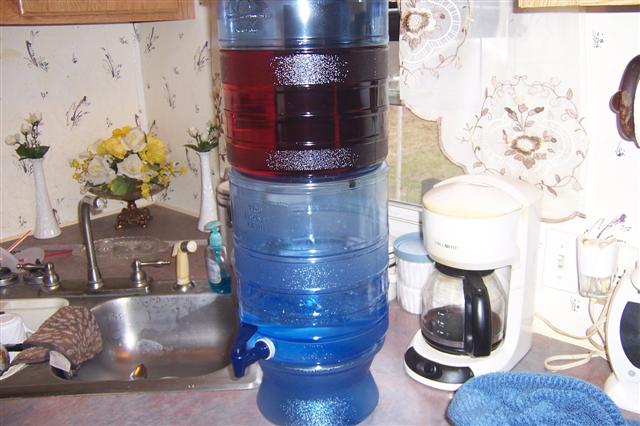
The assembly went quickly and the entire unit was put together in about 15 minutes. This included time to clean the water reservoirs and prime the filters.
The first step in the assembly process is to wash the upper and lower chambers with warm soapy water and rinse thoroughly afterwards.
The second step is to prime the filters using either the priming button (supplied with the filters) or one of the Sport Berkey Bottles. Be careful when priming the filters or you will have water spraying everywhere. You will need to keep a firm seal between the primer button and the water faucet when priming the filters. It took less than a minute to prime both filters.
The third step is to install the filters in the upper chamber. This is easily determined by the two small mounting holes in the reservoir. When installing the filters, it is very important to only hand tighten them.
The fourth step is to install the spigot in the lower reservoir. Once again, hand tighten the spigot to avoid damaging the unit. Make sure you adjust it so that the spigot has the proper alignment for dispensing water.
The fifth step is to assemble the base and the upper and lower chambers. This was easy to do. Simply insert one side and with a little pressure snap the other side in place. You now have a completely assembled water purification and filtration unit. Once assembled, it takes up little more cabinet space than the average coffee maker.
The final step is to perform a Red Dye Test to make sure everything is sealed and properly functioning.
If your unit has been properly assembled, the water will be clear and clean with no evidence of the red dye in your filtered water.
As received, the unit was complete in all aspects. It had all the required parts and the necessary instructions. It assembled quickly in less than 15 minutes and the parts fit extremely well. The only thing you need to add is a Scotch Brite scrubbing pad to occasionally clean the filters per the manufacturer’s instructions. You should also consider keeping the small box the filters came in for transport purposes in case you need to bug out and need to take your Berkey Light on a trip.
My friend made a very good decision when purchasing this unit and it gets a big “thumbs up” from
Special thanks to RW, Jr. for assembling this unit while pictures of the process were being taken by yours truly. Thanks also go to my good friend who allowed me the privilege of checking out his new water purification and filtration system.
Staying above the water line!
Riverwalker
Parenting for Life - Teaching Kids to Survive and Thrive
In today's age of automation, machines do everything for us, from sending our messages to ensuring our continued entertainment twenty-four hours a day. While we aren't on the verge of having our gadgets leap up and attack us at any given second, we have come to rely on them to an extent that they can actually become disadvantages.
Nowadays, it isn't rare to see a teenager glued to his iPod or typing away on a laptop. In lieu of actual sports, many kids play the Wii, substituting a simulated game of tennis or golf for the rigors of the real thing. Our thirst for automation has spread to succeeding generations and the devastating consequences are beginning to make themselves known.
Completely tearing kids away from technology is a hard battle and one that we ourselves have difficulty promoting. After all, the benefits of technology are many and manifest when compared to the subtle negative changes they can affect on a person. However, there are scientific studies that suggest disadvantages and negative effects of continued technological use. Suffice it to say, there are huge benefits to weaning your children from the gadgets they have become so attached to in their daily lives.
With each of these suggestions, it is important to remember that you have to lead by example. Kids won't recognize the benefits if they don't see them in others first, so make yourself the most convincing argument for the advantages of getting back to the basics.
Here are a couple of ways:
Instead of having your children perpetually glued to their music machines or pretending to play an instrument on a video game, encourage them to take up an actual musical instrument. Aside from the sense of accomplishment they get by learning how to emulate their favorite musicians, they also gain the intellectual benefits of musical knowledge. Studies have shown that children that play musical instruments have stronger analytical and arithmetic skills. They also gain tactical skills and improved physical dexterity, which are great advantages when playing sports.
As convenient as using a
Have your children turn off the TV and re-enact their favorite shows instead. This develops creativity by making them create something from scratch. Ask them to write their very own screenplay and help them craft their own props and costumes. Try to set aside one night every week for a backyard play and make it a special production with programs and seating. Invite your neighbors over and throw a backyard party. Not only will you build relationships, but your kids will have fostered the growth of something even more important, their imaginations.
Store that Wii in the closet and get your kids out in the yard for some good old-fashioned backyard sports. Encourage them to indulge in daily physical activity, which helps foster muscle growth and increases circulation, which promotes mental development as well. The social interaction and camaraderie brought about by playing sports results in relationships that last a lifetime and helps improve social and conversational skills.
E-readers are quickly replacing books in modern society, but like all things automated, nothing beats the real thing. These technological advancements, though convenient, can damage eyesight through prolonged exposure to bright lights. They also remove the tactile advantages gained from being able to turn a page, which diminishes the power of concentration in a young brain. Children also fail to enjoy the original artwork present in collector's editions of books that are too old to be included in these e-readers.
Technology isn't completely negative, but just like anything taken in excess, it can be. Teach your children independence and in time they can become inventors of gadgets instead of simply users.
Renee Bedford is a mom and wife who believes in teaching her children to be self-reliant and prepared. She knows that not only will these skills keep them safer, but they will also make them smarter! Besides being a committed mother, she also works for Christmas Tree Market, where they sell an array of classic and unique artificial Christmas trees.
Friday, January 21, 2011
Survival Gear Test - Berkey Light Water Purifier - Part One

One of the most important things you can have in a survival situation is the ability to make sure you have an adequate way to filter and purify your drinking water. Without fresh clean water to drink, you aren’t going to survive anything very long.
One of my good friends for over thirty years recently purchased a Berkey Light Water Purifier and is really excited about his purchase. He called and said it would be here soon. Actually, it arrived faster than he thought…like super quick! Together we are going to do a step by step gear review of this water filter and purification system.
Part One:
The Purchase Decision -
My friend decide to purchase his Berkey Light Water Purifier after checking out the numerous different water filtration and purification systems that are currently available on the market. He was looking for a light weight system for both emergency and everyday use. Being an outdoor enthusiast, the three free Sport Berkey bottles (a $69.99 value) were also a big factor in his decision to purchase this water purifier.
The Order-
My friend ordered his Berkey Light Water Purifier by clicking the link on Stealth Survival (he’s one of my big fans). He said the order process was quick and easy and the various payment options also included the ability to use PayPal to pay for his purchase. He got a quick purchase confirmation e-mail with all the details, including a tracking number for his purchase.
The Shipment -
One of the best things going for the Berkey Light Water purifier from Directive21 is the free shipping. My friend ordered his Berkey Light Water Purifier on January 17th (a Monday holiday!) and it arrived on Thursday afternoon. That’s really quick! Shipping costs are always one of his main concerns because they can run the cost up very quickly. Getting his order in only three days amazed him! He said
The Cost -
When asked about the cost ($209), he stated that when compared with the high prices everywhere for bottled water it was a no-brainer and the three Sport Berkey bottles were a great bonus item.
Safe drinking water will always be critical in any survival situation, Water is not a luxury. It’s a requirement. Don’t neglect this very important aspect of your survival.

The contents and assembly of the Berkey Light Water Purifier will be covered in Part Two.
Staying above the water line!
Thursday, January 20, 2011
Riverwalker's Pics - Dogzilla
Tuesday, January 18, 2011
Survival Foods - Turnips

Most survival foods are ones that are readily available most any time of the year, require only the most basic of preparation and that can be eaten raw or uncooked. Turnips are one of the vegetables that should be considered a survival food. Turnips are an excellent source of vitamin C and are one of the oldest root crops known and have been in use for quite some time. Until the introduction of the potato, they were a staple of European diets. They are also a very hardy vegetable that is well suited for growing in colder climates. While turnips are generally available most of the year, the best ones aren’t usually available until later during the fall months. Turnips are also quite easy to grow.

Turnips, which are actually a member of the cabbage family, can be used raw (shredded for use in coleslaw, etc.), in soups or stews or prepared much the same as you would a potato, basically boiled or baked. Smaller, younger turnips have a milder flavor than older, larger turnips. It’s also important to leave the cover off your pot when boiling turnips to prevent that strong “turnipy” taste that is familiar to most people. To help add some flavor to your turnips, just use some butter, cheese and some parsley or thyme.
Turnips actually don’t store well due to their high moisture content and will dehydrate quite rapidly. They will keep for about 1 to 2 weeks in the refrigerator or they can be dehydrated similar to carrots or other root vegetables.
Turnips can also be used as a feed for livestock.
Monday, January 17, 2011
Riverwalker's Pics - Buck and Does
Riverwalker
Sunday, January 16, 2011
Riverwalker's Gear Pics - Shotgun Scabbard

The shotgun scabbard allows quick access while providing protection for your firearm.
Riverwalker
Thursday, January 13, 2011
Backyard Food Production -How Much Land Does it Take?
When thinking of becoming self-reliant, the question arises "how much land do I need to be able to sustainably grow enough food for my family?" The exact answer to that question depends on several factors, but you can learn a lot, and make a pretty good estimate, by looking at some scenarios that span the various alternatives.
Let’s start first off with the almost magical dream of the pure hunter/gatherer. I often hear this one from those concerned about a collapse of civilization. The shit hits the fan and you take your rifle and a few supplies and head out to the wilderness to live off the land. Just how much land does it take to support you without destroying all the wildlife and plant populations? How much area do you need in order live sustainably as a hunter/gatherer?
Since there are so few actual hunter/gathers left alive on the planet, and the few places where they do still exist tend to be jungles which look nothing like anything in
Before we head off into other more obtainable land use scenarios, lets pause for a moment to acknowledge that in addition to having access to a huge tract of land for living the hunter/gatherer lifestyle, you also need at least a decade to learn the many, many, skills of living such as tracking and hunting, trapping, botany, weather cycles, fiber and cordage, shelter, tool making, fire starting, tanning, and so much more.
OK, so you won't be going that primitive. What about you growing your own food in gardens, food plots, orchards, livestock, and perhaps a bit of hunting? Agriculture has gotten us these high population levels so far anyway, hasn't it? Yes it has, and small scale agriculture is definitely the way to go for most people. So how much land are you going to need for that?
The research to the answer to that question was started back in the 70's by a very forward thinking man named John Jeavons. The work has continued since then and a method developed into a system called "Bio-Intensive Gardening". The Bio-Intensive method has been implemented worldwide to alleviate hunger and malnutrition. There is a wealth of detail in the entire Bio-intensive method, but the short answer to how much land you need can be summarized as approximately 8,000 sq. ft. for a complete diet for one person (you need 4,000 sq/ft. of actual growing space and at least 4,000 sq. ft. for pathways and access). That is also assuming you have four growing seasons per year. So if you can only get two growing seasons, then you need to double the space needed per person. For reference, an acre is 43,560 sq. ft. So in a more southern climate, you could theoretically support about 5 people per acre.
The absolute best reference for the Bio-Intensive method is the book How To Grow More Vegetables Than You Ever Thought Possible On Less Land Than You Can Imagined by John Jeavons (available through Amazon here). And for another comparison, with data taken from Jeavons book, the average
So small scale agriculture is definitely going to be your best bet. My personal experience is that 2 acres in a mild temperate region will completely wear you out and is enough room to comfortably support a family of four with a variety of food sources such as gardens, orchards, small livestock, and wild crafting. You can still do a lot in less area, and of course, everyone always wants more. Some caveats I've got to throw in there is you definitely need about a decade of experience to homestead like this, and you also need enough water. An excellent source for seeing what a diverse sustainable homestead on small acreage looks like is the video tutorial package titled Food Production Systems for a Backyard or Small Farm. The video we have created shows in good detail the systems we've setup to generate a lot of calories per year, how we did it, and why. It is a good example by folks who are actually living it.
But don't forget, even if you live in an apartment, there is a lot you can do. The most important thing is to get started. Did you get a few plants from a nursery, or check out a gardening club yet?
Jacque and Jim Gates are the owners of Bastrop Producers Market, Inc. (www.bastropproducersmkt.com). A market for local, organic, and sustainable farmers. Here is what they say about the
As always, good luck and
Cheers,
Marjory Wildcraft
& the Backyard Food Production Team
www.backyardfoodproduction.com
After a review of their DVD and the Resource CD, this is a fairly straightforward introduction for those persons who wish to become more self-reliant. It does make a couple of things very clear to anyone seeking a more self-reliant lifestyle. It takes a lot of time and hard work.
As an added bonus, this DVD along with the Resource CD will be given away on the Texas Preppers Network.
Staying above the water line!
Riverwalker
Tuesday, January 11, 2011
Stealth EDC - Gerber Mini Paraframe
The Gerber Mini Paraframe Fine Edge knife is a lightweight design suitable for your EDC (every day carry) gear. At slightly more than 3 inches, this small folder with a “frame lock” and clip point design is well suited for pocket carry.
It also works great as a money clip for stealth purposes.
Got stealth pocket folder?
Staying above the water line!
Sunday, January 9, 2011
The Survival Sponge
There are many items that can serve multiple purposes. When survival counts, you need to make sure that you use every item that may be available. By utilizing all your resources, your survival efforts will be a lot simpler to accomplish. Sometimes the simplest item can make a great piece of survival gear. One such item is the sponge.
A sponge is a fairly unique item that can serve a multitude of purposes. They come in a wide variety of shapes and sizes and can be easily trimmed or sized to fit a specific need. The most important aspect of the sponge for survival purpose is not only its ability to hold water but its ability to work as a water collection device. A sponge can be easily used to collect dew, moisture condensation or rain and normally its ability to hold water is only limited by its size. Amazingly though, a sponge, when dry, is extremely lightweight but readily soaks up any moisture to which it is exposed. The fact that sponges weigh little or nothing when dry is an important quality if weight is one of your priorities when it comes to survival gear.
The sponge also has another great use as part of your first aid kit. It makes an excellent cushion for injured limbs that need to be splinted. A small sponge, when slightly moistened becomes very pliable and makes an excellent source of cushion material for an injured finger or toe that needs splinting. It can even be used as an improvised eye patch.
Many of the uses for a sponge are fairly obvious and are commonly used for such purposes. They are great for taking a bath, also known as a “sponge bath”, when water resources are limited. Proper hygiene is always important in a survival situation. They can even be used to wash and clean cooking and eating utensils.
Got sponge?
Staying above the sponge soaked water line!
Saturday, January 8, 2011
Snowed Under
Been extremely busy with work the last fews day and there hasn't been much time for sleep or anything else for that matter. Had to take on some additional duties but things are looking a lot better. To make matters worse there was some kind of 24 hour stomach virus going around and it managed to catch me and decided to stay around for more than the usual 24 hours or at least it seemed like that. Things are starting to come back to normal, albeit slowly.
Plans are still in the works for some more gear tests. With the possibility of what looks like record breaking low temperatures headed my way, it may not be possible to get them done very quickly. Mrs. RW and RW, Jr. got me a few gear items that were on my wish list and hope to check them out soon.
Several of the items have been on my list for some time and my new tactical shotgun scabbard looks great. RW, Jr. also got me a laser and light set-up for my Mossberg 500 that has worked out well. Plus there is a new heat shield and some ghost ring sights that have been added to it. More on all this later.
Right now my plans are to curl up on the couch with a good book, Out of the Dark by David Weber, and put my new poncho liner(in digital camo no less!) to the test.
Staying above the water line!
Tuesday, January 4, 2011
Worst Case Scenario - The Mass Bug-Out
Anyone who has lived on or near the coast for any appreciable length of time has experienced the effects of a mass bug-out. Just when you think you are located in a relatively safe area, here comes a mass of humanity headed directly towards your area in an effort to get out of the way of an impending disaster …generally a really bad hurricane as far as most coastal areas are concerned.
Now when a large mass of humanity all starts moving out of an area, the effects will be similar to a large number of grasshoppers appearing in your pasture. They will strip everything bare and leave little of anything in their wake. Lack of preparation when combined with a certain level of panic both contribute to this problem. All of a sudden you realize that the arrival of a large population of displaced people is going to put a strain on your available resources.
Similar to the herd instinct of most animals, this mass of humanity once they get moving will trample anything and everything in their path to avoid the effects of a disaster. During Hurricane Katrina, the interstate in my area was completely useless to people in the local area. Even the secondary highways in my area were clogged with large amounts of people and traffic. A simple 45 minute trip took over two hours to accomplish and was only possible by using back roads that people unfamiliar with the area weren’t even aware of their existence. Another similar situation, although not as bad, occurred during Hurricane Ike.
Along with the traffic congestion, came the problem of just accessing routine items such as gasoline and food. Lines at convenience stores were so long that they were blocking nearby intersections, which caused even more traffic congestion. And those people who couldn’t get fuel for their vehicles or suffered a mechanical breakdown (forget about AAA!) wound up stranded on the side of the road. Forget about buying food, bottles of water or batteries. Shelves were stripped bare in most stores along the evacuation routes in a matter of hours and the possibility of re-supply was non-existent for the present. People were literally fighting for what was left.
Now in a worst case scenario this is probably what should be considered a localized event. It is fairly limited in its scope because it is happening in a fairly generalized area (those closely affected by hurricanes). What about a disaster with even more serious consequences? After 911, many people were absolutely terrified to be in any type of skyscraper in any city because of the possibility of it becoming a target. Any major city or urban area could find itself in the same position. A terrorist threat, a major outbreak of a deadly disease or anything of a similar nature could create a scenario where there could be mass evacuations from a number of large urban areas at the same time because of the panic that could be caused by the “What if my city is next?” syndrome. The resulting displaced masses will be a very real threat to your survival. A failure to be prepared could have disastrous consequences.
In most cases your home is going to be your best survival option, there will be those times that you may need to avoid the stampede...
Staying above the water line!