Search Stealth Survival

Loading...

Sunday, October 31, 2010

Bushcraft - Central Texas Style - Zombie Spiders

Catalepsy, the act of pretending or appearing to be dead, is a defensive technique commonly used in nature to thwart predators. Spiders share this particular trait with many other insects and vertebrates (such as the possum). A spider which falls from a leaf or branch or is brushed from your clothing will curl its legs around itself and lie still for several minutes. This is a survival strategy which is used to thwart a predator’s attack. It is quite convincing in its appearance of being dead, but if you are patient enough and maintain your surveillance it will miraculously and suddenly come back to life. It will then hurriedly scurry off to a place of safety.

Camouflage, mimicry and catalepsy are all forms of survival strategies and all of these forms of defense are used by a wide variety of spiders. Humans are not normally considered prey by spiders and are usually only a threat when they are molested or their young are endangered.

It is important to have an understanding of the defensive strategies and survival techniques used by many of nature’s creatures. Quite often it is our fear of the unknown which is our biggest threat to survival. This is a threat which can be easily conquered by the proper knowledge of those creatures that live around us.

Got zombie spiders?

Staying above the water line!

Riverwalker

Saturday, October 30, 2010

Riverwalker's Gun Pics - Ruger MKII 22LR Pistol

Right Side View


Left Side View


Staying above the water line!

Riverwalker


Thursday, October 28, 2010

Wild Chile Penguins


Wild Chile penguins hunt in large groups and they are extremely dangerous to sardines.

They are also skilled at staying above the water line!

Pic source: http://en.wikipedia.org/wiki/Magellanic_Penguin

Riverwalker


Wednesday, October 27, 2010

The Survival Mindset - Conserving Time and Energy

Your time and energy are valuable resources in a survival situation. You don’t want to waste your efforts on activities that may have little or no immediate benefits to your survival. Staying focused on your immediate needs will allow you to conserve your resources. While many things seem like a good idea at first, in practice they may waste more time and energy than they yield in actual benefits. Through no fault of your own, many ideas are generally unlikely to succeed due to the limitations of your resources or skills.

It is fundamental to your survival that your expectations do not exceed the skills or resources you have available. Elaborate and complex ideas or plans will be even harder to accomplish if you are in a survival situation. Don’t make your survival any harder than necessary. Simple solutions are quite often the best and easiest to accomplish when faced with what may be limited resources or skills.

When it comes to survival, keep it simple!

Staying above the water line!

Riverwalker

Tuesday, October 26, 2010

You might be a survivalist if…

You might be a survivalist if…

1.) You built a log cabin with your pocket knife.

2.) You carry more than one survival kit…just in case.

3.) You can reload your ammo with a multi-tool.

4.) You have a flashlight on your keychain and your shotgun.

5.) You know a dozen ways to start a fire and still carry a Bic lighter.

6.) You don’t consider calling 911 a survival option.

7.) You never consider yourself lost, even if you don’t know where you are…yet.

8.) You filter and purify the water from a public fountain before drinking it.

9.) You have a wardrobe with only one color…camouflage.

10.) You like to practice building a shelter during thunderstorms.

11.) You prefer reading material that has survival in the main title.

12.) You have more home security measures than most prisons.

13.) You prefer wild game suppers when dining out.

14.) You have a dozen can openers but like to open your cans without one.

15.) You have a first aid kit with only two band-aids and a package of aspirin.

16.) You can’t wait for the sun to go down so you can test your new flashlight.

17.) You have considered using the neighbors’ pets as pistol targets and an emergency food source.

18.) You have an observation post in the backyard disguised as a tree house for your kids.

19.) You have an emergency cash fund bigger than your bank account.

20.) You serve MRE’s to your relatives when they visit.

21.) You carry a compass when you go to the shopping mall with the wife…so she doesn’t get lost.

22.) You have almost as many knives in your collection as your wife has in her kitchen.

23.) You have more ammunition in your gun safe than most stores have on their shelves.

24.) You have more plants in your yard with big, ugly thorns than flowers.

25.) You constantly check the water quality of the pools in your neighborhood for drinking purposes.

And lastly, you read Riverwalker’s blog, Stealth Survival.

Staying above the water line!

Riverwalker

Monday, October 25, 2010

Bushcraft - Central Texas Style - The Dakota Fire Pit

Dakota Fire Pit

Making efficient use of your resources is a good practice when building a fire. The Dakota Fire Pit is one of the most efficient styles around and will help you in making the best use of your available resources. They are less visible and more fuel efficient than other types of fire and can be easily made from the camp tools used by most people.


The major trick in making a Dakota Fire Pit is the chimney. Through the use of a chimney hole fresh air is drawn into the fire pit as the heated air in the main fire pit rises. This makes a very fuel efficient fire. The hard part is digging the chimney hole for the main fire pit. The easiest way I’ve found to dig the chimney hole is to use tent stakes that are normally 8 to 10 inches long to dig out the hole for the chimney and round it out with the handle on your camp shovel to get a pretty uniform shape. I also use the tent stakes to set the depth for my main fire pit at about 8 to 10 inches.


I also like to use a couple of cotton balls coated with Vaseline as tinder to start my fire. Simply pull the cotton balls slightly apart and light your tinder. The kindling catches fire quite easily and in no time you’ve got a decent fire going.


A few pieces of green sapling can then be used to make a grill for your Dakota Fire Pit. Be careful though because the green saplings will eventually catch fire since the Dakota Fire Pit is very efficient and puts out quite a bit of heat. Its design also makes it very easy to put out your fire and leave little or no traces behind when you are finished.

Put on a coffee pot and you’re ready to go!

Got Dakota Fire Pit?

Staying above the water line!

Riverwalker

Sunday, October 24, 2010

Senior Survival Solutions - Ten Ways to Avoid Vulnerability

One of the most serious threats to senior members of our society is the fact that many are seen as more vulnerable due to their age or infirmity. Predators of all kinds will always seek out what appears to be the weakest individuals when on the hunt. They will single you out and attempt to take advantage of your vulnerability if you allow it to happen. Your vulnerability often comes from the feeling that you have no control over the outcome should you find yourself under attack. With a little advanced preparation and planning, you can avoid these types of situations altogether or exercise the necessary control to make sure that when such a situation happens you will be in control and therefore be less vulnerable.

A feeling of vulnerability can lead people to feel more endangered and threatened in almost every aspect of their daily lives. Your basic sense of trust and feelings of security can be altered until they have a negative impact on your safety and your life in general. While we would all like to believe that the world is a safe place to live in, these expectations are not really the result of rational thought but may be more a result of wishful thinking on our part. If we allow our feelings of vulnerability to overcome us, they can become a breeding ground for the numerous fears that will affect our comfort levels and our sense of security in performing routine daily activities.

The first thing you should do is prepare yourself mentally for these situations. Think about the different scenarios you may find yourself in and look for solutions that you can easily implement into your daily routine. Learn to think both tactically and strategically in order to minimize your vulnerability and reduce your risks of becoming a victim.

Secondly, you should learn and apply the various self defense and personal security techniques that will allow you to avoid placing yourself in a vulnerable position and thereby avoid endangering your survival. Many of these techniques are very simple and easy to incorporate into your daily routine.

There is a given amount of uncertainty in all our lives. This is a simple fact that we all have to face whether we want to or not. The uncertainty of events in our lives becomes a needless burden if we fail to realize that it exists and can lead to a wide range of extremely negative emotions. These negative emotions will only cloud your reasoning and prohibit you from effectively dealing with situations where you may be vulnerable. Denial and avoidance of the reality that you won’t find yourself in a bad situation is not an effective survival strategy.

Staying calm, keeping your wits about you and applying logical, well thought out solutions is going to be one of the most effective way to control the events in your life. This can only help to reduce your vulnerability. By employing some simple survival strategies, you can reduce your fear of being vulnerable in a world where there is an increasing amount of threats to our everyday activities. Hard times and desperate people quite often will try to take advantage of any opportunity you give them. Don’t make things easy for them!

Senior Survival Techniques and Strategy

1.) Use Group Survival Techniques - Plan your activities so as to be part of a group.

One of the most effective means to reduce your vulnerability is to utilize the advantages of being part of a group. There is strength in numbers and being part of a group will reduce your vulnerability. Even a small group of three or four individuals will be a huge deterrent to most anyone seeking to take advantage of you.

2.) Avoid Solo Excursions - Plan your activities where you will not be by yourself.

One of the worst things you can do is place yourself in a situation where you will be by yourself. Your safety will be entirely dependent upon your own capabilities. If you are hampered by any type of infirmity that reduces your abilities, you will be vulnerable and there is always the chance that it will be perceived as a weakness that others may seek to take advantage of for their benefit.

3.) Ask for Assistance - Don’t be afraid to ask for help or assistance.

Many times we may be afraid to ask for assistance or help so as to avoid creating a burden for others. Try to make sure that when seeking assistance from others that it doesn’t involve creating a burden. Try to plan your requests for assistance so as to avoid putting a strain on the activities of those from whom you are seeking help. Remember that things like having to take off work or canceling their own plans in order to assist you are a burden. Try to coordinate your needs for assistance with their activities.

4.) Keep Your Home Secure - A properly secured home environment is critical.

Make sure to have proper lighting for all outdoor areas (porch, yard etc.) so that visible threats can be easily recognized and dealt with appropriately. Make sure that all doors and windows have effective and properly installed locks or safety devices. Make sure that their use is a common practice and part of your daily routine.

5.) Maintain Effective Communications - Have effective communication available.

With the advent of cell phone technology, the ability to summon help when needed is easier now than at any other time in our history. If threatened, injured or in need of help, it can prevent you from becoming placed in a vulnerable situation when you may need emergency assistance during a critical situation. Stay in touch with other family members.

6.) Avoid Distractions - Maintain an awareness of your surroundings at all times.

Awareness of your environment can be critical. Don’t allow yourself to become distracted to the point where you may not be able to recognize possible threats in advance. It should also include an awareness of how others perceive you. If you allow yourself to be seen as weak or vulnerable, others will notice this behavior and you could ultimately put yourself at risk. Your appearance should be one that shows confidence and capability. Always try to develop a continual sense of awareness and pay strict attention to the world around you. The last thing you want to do is to let someone or something sneak up on you when you least expect it.

7.) Avoid Frustration - Frustration only increases your vulnerability.

Frustration is a normal part of life. We don’t always get things our way but this should not become a deterrent that will keep you from reaching your goals. It is nearly impossible to prepare in advance for all the things life may throw at us. This doesn’t mean we shouldn’t try to prepare ahead of time. There are numerous things that will interfere with our daily lives and avoiding or limiting the effects of these items will reduce the amount of frustration you will have to deal with on a personal level.

8.) Avoid the Perception of Being Vulnerable - Don’t exhibit the appearance of being vulnerable.

If you are perceived as vulnerable, you may only increase the chances of someone trying to take advantage of you or the situation. You should also remember that appearances can be deceiving and a threat may not be easily recognizable as a result. Learn to trust your instincts. If something doesn’t look or feel right, it’s probably not.

9.) Utilize Means of Personal Protection - Be ready to defend yourself at all time.

Utilize any means possible to insure your personal safety. A simple walking cane or an umbrella can be an effective means of personal protection. Pepper sprays or stun guns can also provide further elements of personal protection. Additional personal protection can even be provided through the use of firearms but only if you can safely, effectively and efficiently use them without further endangering your own survival.

10.) Use All Your Resources - Don’t place limits on your available options.

Use any and all options at your disposal. Don’t place arbitrary limits on your abilities that could increase your vulnerability. You are only as vulnerable as you allow yourself to be.

These are but a few of the strategies and tactics that can be used to help reduce your vulnerability in a world where the unexpected can happen at any time. With advance planning and preparedness you can meet the challenges of everyday life that may threaten your survival. Many of these techniques can also be applied to non-senior family members.

Got senior survival solutions?

Staying above the water line!

Riverwalker

Riverwalker's Pics - Wild Chile Pequin

Chile Pequin

These small but very powerful chile peppers grow wild in numerous areas of South Central Texas. They make an excellent hot sauce that can be used to flavor and add a little spice to numerous food dishes.

Got peppers?

Riverwalker

Saturday, October 23, 2010

Urban Survival Tip - Finding Emergency Shelter


Many people fail to realize that the vast majority of homeless people are very smart. They know how to survive and have become masters at the art of survival. Finding emergency shelter is one of the practices that many homeless people are very good at finding in an urban environment. Learning some of their simple tricks can help you to adapt to your urban surroundings in an emergency or crisis.

The most common form of emergency shelter in an urban environment is the clothing donation box. Many look like little houses and most even have a pitched roof. Homeless people have known about and used these for shelter for a long time. In larger cities they are everywhere and can provide a ready-made shelter from the cold and the rain. They can also provide a source of additional clothing if needed. Even in smaller towns they can be easily found and work great as a form of emergency urban shelter.

Got emergency urban shelter?

Staying above the water line!

Riverwalker

Friday, October 22, 2010

The Fragile Nature of Infrastructure

There hasn't been a major disaster and yet the effects of technology can be lost due to simpler things. A major construction project in my area has done exactly that. A major fiber optic cable was damaged the other day during some construction and suddenly communications were sketchy and there was no ISP available. My apologies for not posting anything the last couple of days due to this problem. The hardest part is that you get behind on everything. One of my co-workers, who spends a lot of time on the net at work for business purposes, had his efforts completely shut down. I'm spending some time catching up on my stuff as well.

We sometimes forget that it doesn't take a major disaster to create problems. The fragile nature of our infrastructure is in itself a major weakness of our system. With little or no back-up systems in place, it doesn't take much of an event to shut things down or disrupt your normal routine very quickly. Our technology dependent lifestyles are easily changed by the the smallest of these disruptions.

Mrs. RW even had major problems at work and it seems that there was an effect on most everyone's routine throughout the area. Two days of repair has managed to get the system operational again. The real question is for how long or will it last only until the next time someone accidentally digs up an underground cable and brings everything to a screeching halt once again.

There is a fragile nature to our infrastructure and a dependence on a system without sufficient back-up systems or a readily available alternative system in place is just an accident waiting to happen!

I'm looking for a couple of tin cans and a string just in case!

Got technology?

Staying above the water line!

Riverwalker

Tuesday, October 19, 2010

Simple Survival Skills - The Traditional vs. Non-traditional Solution

If you suddenly experienced the loss of all your “stuff”, which is a commonplace occurrence in many survival situations and crisis scenarios, have you trained yourself to think outside the box and come up with an alternative, non-traditional solution?

Having “survival stuff” can be very reassuring and a great comfort to you in a crisis situation but it may not always be there to save you. A failure to be able to think in “non-traditional terms” when it comes to survival can be an invaluable skill. Your ability to stay focused on your most immediate and critical needs for survival may depend upon being able to think of solutions that are both strategic and tactical in nature based on your current resources. A failure to utilize all the available resources that may exist, even those that aren’t immediately recognizable, may create a situation where your chances for survival can be endangered.

There’s a lot of truth in the old saying, “There’s more than one way to skin a cat!” (my apologies to the cat people out there). Too many times we develop a sort of tunnel vision and can lose sight of even the simplest of solutions. There are many items that can be used in non-traditional ways and have a multitude of uses. Being able to see alternative uses for simple things may become critical to your survival. There are a number of items that have multiple uses and quite often these additional uses can go unrecognized if we only we see things in the sense of their traditional use.

There are many examples of items that can be used in non-traditional ways to aid you in your survival efforts. A safety pin becomes a fish hook, a strap becomes a tourniquet, a tin can lid becomes an edged tool, a rock becomes a hammer, a bandana becomes a water filter or an empty can becomes a cook pot or drinking cup. This list could go on and on forever. The possibilities are only limited by your brain’s ability to improvise and seek innovative solutions that may involve a “non-traditional use” for your available resources.

Staying above the water line!

Riverwalker

Sunday, October 17, 2010

Senior Survival Solutions - Handles and Wheels


It’s a simple truth of life that as we get older our bodies aren’t capable of performing tasks as well as when we were younger. Even if you’ve managed to avoid some of the things that plague us as we get older, your body will still impose certain limitations on your abilities. Being prepared to handle these limitations can help you survive an emergency or crisis. Even younger family members may have limiting disabilities that need to be addressed prior to an emergency.

Many families have senior members who have infirmities that may limit their physical abilities but have many of the same needs as younger members without these limitations. One such need is the bug out bag or get home bag depending upon your particular view of things. There is always the possibility that you will need to leave the safety and comfort of your home due to the need to evacuate because of an emergency.

Being somewhat older myself, if you consider being 60 old, I can handle a bug out bag that weighs a considerable amount (upwards of 40 pounds) quite comfortably. Mrs. RW on the other hand can’t and prefers to use a luggage carrier with handles and wheels. This takes quite a load off but still has very functional portability. While backpacks can be the ultimate in portability and ease of carry, a bag that has a handle and wheels can be a blessing for someone who may have arthritis or lack the physical strength to lug a heavy bag around on their shoulders.

I also use a bag with handle and wheels for those heavier items that would have a tendency to put a strain on even my physical abilities. The bag pictured above is one of those insulated soft-sided coolers that I use to carry extra food and water if we have to bug out (it also works well for those weekend get-togethers that are popular in my family). At 8.6 pounds per gallon, even a small amount of water will get real heavy very quickly and a bag with wheels and a handle lightens the load considerably.

Addressing the total needs of your family members should include those family members that have limitations on their abilities. Whether their limitations are from age, injury or illness, there are simple survival solutions for them as well.

Staying above the water line!

Riverwalker

Saturday, October 16, 2010

Natural Forms of Shelter


Many times you don't have to build a shelter but need merely take advantage of what nature has to offer. Natural forms of shelter require little expenditure of effort and resources. They are quite literally "ready made" for your use.

Got natural shelter?

Staying above the water line!

Riverwalker

Wednesday, October 13, 2010

The Pocket Axe - Gear Test Update

The Pocket Axe

Testing your gear in non-critical situations should always be a priority. New gear may look nice but the true test comes in how it performs when needed. Gear that breaks or fails to perform the needed task can be virtually useless in a survival situation. Here's the simple test done on my pocket axe.


Chopping Small Limb

Mrs. RW had decided to trim some limbs from a few of the trees in our yard and I figured this would be a good time to check out the chopping abilities of my pocket axe. Being small and lightweight is a good thing. I needed to see if it would chop wood when needed. The first thing I did was to chop a small limb that was approximately one inch in diameter. This took less than two minutes and was probably more like a minute and a half. The first thing that happened was the cord wrap was too loose and slipped upwards on the handle. This affected my grip somewhat but was manageable. You can see a slight gap in the cord in the above picture. There was plenty of additional cord hanging loose and a quick re-wrap with the extra cord and a little tightening up of the cord wraps helped the grip a lot.


Limb Measurement

This picture shows the diameter of the first small limb that was chopped with my pocket axe.


Chopping Bigger Limb

After adjusting the cord on the handle to get a better grip, I then proceeded to cut a larger limb of about 2 inches in diameter. This only took a couple minutes and tightening the cord on the handle solved the slippage problems when cutting the first limb. You can see the shortened length of cord in the above picture. When it came to chopping small limbs, it did an excellent job and the scuff marks left on the finish cleaned off easily with a little soap and water. It's important to keep your gear clean and ready for use.


Bushcraft Hammer

The next step was to test its wood-splitting abilities and I could think of nothing better than to use a bushcraft hammer (a.k.a. rock). The bushcraft hammer is a versatile tool and found easily most anywhere and anytime. You don't even have to carry one as part of your EDC gear because nature will provide one for you when needed. It will also let you know quickly if your gear will hold up. The main problems with this pocket axe is its short handle and lack of weight. It was hard to set the axe into the wood without a little assistance from the bushcraft hammer. Although, it easily split some 4 inch diameter chunks of oak that I had set aside for use in my smoker barrel, it did require a couple of taps with the bushcraft hammer to get it started. Once started, it then split the wood chunks easily. It was primarily a safety issue as I didn't trust the pocket axe to not slip and cause a possible injury when splitting the wood chunks.

Special Note: Use of a bushcraft hammer (a.k.a. rock) is not recommended for general use as it may cause gear failure.


Pocket Axe Kindling

It took less than five minutes to split a couple of chunks of oak into some decent kindling for a small fire (Native American style). If you're planning on building a bonfire (white man style), you'll need a lot bigger axe than this one. A decent amount of wood for a small fire could be still be split in a short amount of time. Its primary use is to be an easy to carry axe that would fit easily on my belt or in a small backpack allowing the ability to chop a little wood when making a fire. This small pocket axe will take care of that task. You will still need a larger axe for regular use in camp.


Finish Damage

Although there was no damage to the finish from chopping small limbs, there was some chipping of the finish that occurred when it was used to split some wood chunks. The above picture shows the chipped finish on the bevel that leads to the edge. Although disappointed by the damage, it didn't hurt its functionality and shouldn't be a problem as long as I keep it properly cleaned. The edge held up well with no apparent dulling even after splitting some oak chunks. Though the finish was marred somewhat, it still performed adequately.


Sheath Modifications

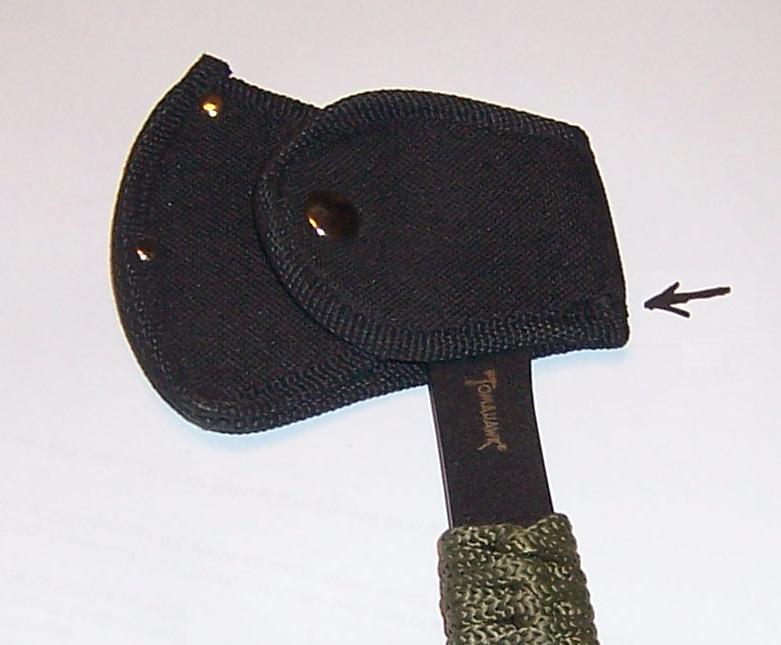
I wore the axe on my belt for several hours during the day. It was barely noticeable if my shirt was left out instead of tucked in. This is great for when you may need to use a "stealth" carry mode. With its light weight, I barely noticed it was there. Even when sitting, I was hard-pressed to notice its presence. There was a minor problem with the sheath in that it was fairly loose and the bottom of the axe had a tendency to slip out partially. Although it never slipped out completely, it did present the opportunity for loss of the axe. This was quickly fixed by Mrs. RW who put a small amount of stitching on the bottom side of the sheath to eliminate this problem (see arrow in pic above). This made the axe secure enough in its sheath to eliminate the possibility of losing it.

I had considered testing its ability to chop ice but this time of year there isn't much ice available in South Central Texas. The thought of using ice cubes from the refrigerator for a little testing had crossed my mind but a lack of ice cubes for her tea may have upset Mrs. RW and this idea was quickly abandoned.

Another option for improving this pocket axe is to see how hard it would be to customize it with a set of wooden or antler grips on it instead of the cord wrap. I'm also considering using this as a pattern to make a hand-made one out of a piece of carbon steel with some further additional modifications. These projects will have to wait for a later time.

Overall, I'm well satisfied that I now have a decent piece of lightweight and compact gear that should prove versatile and useful. If you're into ultra-light backpacking, a pocket axe is something you should consider adding to your gear. While this pocket axe won't replace your need for a regular camp axe, it would work well for a short day trip or hike from camp.


Staying above the water line!

Riverwalker


Tuesday, October 12, 2010

Survival Basics - Primary Needs - Shelter - Dressing for Survival

Shelter is a basic need required by everyone. Our skin alone does not afford us the protection we need to stay alive in the hostile environment that nature sometimes throws at us. Shelter is usually defined as that which protects us from the elements of nature that can endanger our survival but is often neglected in its most basic form. That most basic form of shelter is the clothes we wear on a daily basis. Being properly dressed for your environment will be your first line of defense as a shelter for you against the elements of nature.

Modern technology has made it possible for us to live in the relative safety of an artificial environment that keeps us cool when we are hot, warm when we are cold and dry when it is wet. As a result, we often fail to dress appropriately because we know that the comforts of an artificial environment that will protect us are readily available.

In the absence of that artificial environment, we become extremely vulnerable to conditions that could endanger our very survival. The effects of hypothermia or heat exhaustion can develop quickly if we are unprepared. Simple things like having a hat and sunglasses available on a hot day, a jacket or pair of gloves should the temperature drop unexpectedly, or rain gear should an unexpected rain storm develop will enable you to survive these events that are often unexpected but can have serious consequences. Simple protection will be available from these simple items of clothing if needed.

In Central Texas, it’s not uncommon for summer temperatures of 100 degrees or more to suddenly drop 25 or 30 degrees when a thunderstorm rolls in. Suddenly and without much warning, you find yourself cold and wet and looking for shelter that is warm and dry as the temperatures plummet. A light jacket or windbreaker along with some simple raingear would have avoided this situation.

There is always the risk of technology failing when you need it most. It seems that air conditioning units always break in the summer and heaters always break down in the winter. Yet many people will forget to keep that most basic of shelter items, proper clothing, readily available should a need arise unexpectedly.

Staying above the water line!

Riverwalker

Monday, October 11, 2010

Riverwalker's Pics - River Cane at Dusk

River Cane at Dusk

Many times there is a simple beauty in nature. Sometimes you need only slow down and enjoy the scenery.

Staying above the water line!

Riverwalker

Sunday, October 10, 2010

Riverwalker’s Gear - The Pocket Axe

Compact and lightweight gear usually means the difference between it being carried on you or being left back at camp. Most small camp axes are actually quite heavy and their major use is for chopping large amounts of firewood. This is great if you don’t have to pack that axe all day. But on short or extended trips from camp, you’re probably not going to bring it along.

Too many times a good knife has been ruined or damaged by using it for other than its intended purpose. I've been there and done that! The problem was to find a small, lightweight axe that could be used on short outings or a day hike for “minor” chopping duties and still be easily carried without adding a lot of extra weight. This would also facilitate building a small fire to keep warm, cook a meal or to boil water in order to purify it.


At 9 inches in length and at a weight of slightly less than 10 ounces, this particular pocket axe seems to solve the problem. It is made from a solid piece of steel that is approximately 3/8 inches thick and has a cutting edge length of 3 inches. The handle has a slight curve to it and the axe also came with a nylon sheath with a belt loop. It also has a lanyard hole and a secondary hole about 4 1/2 inches up that allows the handle to be wrapped with cordage. This little axe will quite literally fit in your pocket.

This pocket axe is almost like a ulu with a handle. The blade is too thin for major wood-splitting chores but should work easily for splitting small pieces of kindling. You won’t be clearing any forests with this pocket axe but that’s not its intended purpose. It was also cheap enough that if it became lost it wouldn’t create major damage to my pocketbook. Some minor chopping has shown that the blade edge seems to hold up fairly well so far. A proper wilderness field test will ultimately determine its actual durability.

You can read about a gear test of the pocket axe here:

Pocket Axe-Gear Test Update


Got pocket gear?

Staying above the water line!

Riverwalker

Saturday, October 9, 2010

Survival Communication - Tools for Sight and Sound

Many survival scenarios will depend upon your ability to communicate your situation to others in order to be found or rescued. It is therefore important to remember that effective communication involves both sight and sound.

While our hearing and sight may not be the best due to our physical limitations, there are simple and effective ways to enhance our ability to communicate. A couple of simple and ordinary items can help you communicate in a more effective matter.

The Whistle

Communicating with sound is a normal means of communication familiar to everyone. While some people seem able to talk forever, they can quickly revert to yelling and screaming when the worst happens. This won’t be sustainable for a very long period and a painful moan can be even harder for someone else to hear. This is when you will need a simple whistle. The sound of a whistle is easily heard, can carry a long distance and is more sustainable for a longer duration than yelling till your lungs pop. A whistle is one of the most effective ways to communicate by sound in both daylight and darkness.

The Mirror

Visual communication is also an effective and common means of communicating. We wave at people at people every day but sometimes we go unnoticed because we failed to get their attention. Flash a bright light in their eyes and all of a sudden you’ve got their complete and undivided attention. This is when a simple mirror becomes an effective means of communication. A little reflected sunlight hitting them in the eyes will get someone’s attention in a hurry. Bright flashes of light are an effective way to get noticed quickly and most any reflective surface can be used for this purpose.

Got sight and sound for survival?

Staying above the water line!

Riverwalker

Thursday, October 7, 2010

Gun Fever

Gun Fever


It looks like gun fever has set in once more. An opportunity may be forthcoming that will allow the purchase of an additional gun or two to help round out my collection. One or two more good firearms will always come in handy and hopefully they might be in a caliber that fits in with my other firearms. This will avoid the problem of having to stock additional types of ammo.

A friend has told me that he is planning on selling some rifles and pistols to help raise some money and has asked if I was interested in buying any of them. I told him that I was definitely interested and had the cash ready if it was something I could use. That emergency fund can come in handy, even when there's no emergency. My emergency fund is going to help me take advantage of what could be a decent opportunity to buy a couple of additional firearms.

The basic plan is to help out RW, Jr. build up his firearms collection and perhaps have something additional for my own use out at the farm. My brother-in-law who lives fairly close could also use an additional firearm and he’s always a big help at keeping watch over my place when I’m not around. I’ve been keeping an eye out for something decent for him as well. Hopefully, the prices will be decent enough to add to my collection and perhaps help my son and brother-in-law too.

Got gun fever?

Riverwalker

Wednesday, October 6, 2010

Bushcraft - Central Texas Style - Natural Mosquito Repellant

Beautyberry

One of the main problems for anyone who has spent any amount of time outdoors is that pesky little critter known as the mosquito. Using some of nature’s own plants can help you solve this problem if you know where to look. Fortunately, nature has enabled this natural mosquito repellant to be found quite easily.

The beautyberry (Callicarpa Americana) is a native plant that is found quite easily due to its shiny purple berries that appear almost metallic in color. They are found growing along creeks and riverbeds in moist or dry conditions in areas of full sun, shade or partial shade.

The leaves and berries can be crushed in your hands and rubbed on your body for use as a fairly good mosquito deterrent. I would probably just use the leaves since the berries were also used in making a dye for fabric. You may have a hard time explaining the purple tint to your skin otherwise. This use dates back a couple of hundred years and branches of the plant were quite often used by farmers and ranchers to keep mosquitoes and horse flies off their livestock.

The berries of this plant are a favorite of mockingbirds (the State Bird of Texas), squirrels and other small mammals. Mockingbirds will quite often chase other birds away from a bush in an effort to protect their food source. The leaves are also a favorite forage item of white-tail deer.

Although the ripe berries are edible, they have a fairly bland taste but are quite often used to make jelly. Some even have a mild spicy flavor and the best tasting ones are usually found on plants growing on or near a riverbank or creek. The leaves and berries were also used for medicinal purposes by many Native Americans.

They make a great addition to your landscape and are disease and drought resistant.

Note: Wild plant foods can cause differing reactions among people and although beautyberries aren’t listed in any toxic databases they may still cause adverse problems or reactions for some people.

Got mosquito repellant?

Staying above the water line!

Riverwalker

Sunday, October 3, 2010

Survival Gear - The Weight Factor

While having the right gear can make your survival efforts easier, there are two important factors to remember. The first consideration is having gear that is not on your person or in close proximity to you may not be of much help in a survival situation. As a result, you may be limited to what you can carry on your person. This simple factor can be very limiting depending upon your skill levels, your survival knowledge and your present physical condition.

While skill levels can be improved through practice and your survival knowledge can be increased through study of various survival tactics, the amount of gear you can carry will still be limited. Even persons in superb physical condition will have a limit when it comes to carrying a certain amount of gear. Persons who have limited physical abilities will have even greater restrictions that may affect their ability to carry necessary items for their survival.

Having been an avid hiker and backpacker for many years this was a lesson that was quickly learned. A heavy pack that included items for me and two kids made for a pretty good load that tested my limits when I was younger. Loads that ranged close to 40% of my total body weight made for some difficult trekking. These were loads, that even in decent physical shape and with few actual physical problems, that are no longer possible for me to carry safely as I’ve gotten older. Sometimes you will have to set a limit that will not endanger your survival efforts.

Gear loads that run in excess of 20 to 25 per cent of your total body weight will create what may be an intolerable physical strain on your body. Gear loads can be difficult to handle even with these lower limits and may not be possible even at these reduced limits. This is why you need to be careful in how and what you carry for survival.

Take a person with an average body weight of 160 pounds. At a level of 25% of body weight, that equals 40 pounds. That’s roughly equivalent to that large bag of dog food you lugged from the vehicle to the inside of your house, while complaining that the dog eats more then you do. Even at a 20% level, that would still be an astonishing 32 pounds to carry. Try simply walking a short distance while carrying a backpack that weighs 32 pounds and see how far you will get. This could be a quick lesson in the real world of survival.

When considering the weight factor, try to use items that are compact, lightweight and have value as multi-use items. This will help decrease your load while maintaining the versatility of your gear and reduce the physical strain on your body. Give proper consideration to what you will actually need and place a limit on extra items that may add relatively small amounts of additional value to your survival efforts. Pay close attention the weight of your items and gear you consider necessary for your survival and look for ways to reduce that weight.


Remember this simple truth, knowledge weighs nothing but is your most important survival gear.

Staying above the water line!

Riverwalker

Saturday, October 2, 2010

Flea Market Search


Things have been pretty busy the last few days. The plan is to now visit a few flea markets in my area in search of a good hatchet to use when practicing my bushcraft. Plan on looking for something compact and lightweight. Hopefully there will be some vendors around with decent stuff.

Search results will be forthcoming.

Staying above the water line!

Riverwalker
Related Posts with Thumbnails